Showing posts with label adventure. Show all posts

Thursday, 3 January 2013

"Apocalypse," by Dean Crawford

Creative Commons License
Stuff and Nonsense by Amy Cockram is licensed under a Creative Commons Attribution-Noncommercial-No Derivative Works 2.0 UK: England & Wales License.

I have previously read Dean Crawford's two earlier books, "Covenant" and "Immortal," and I have written about them in previous posts in this blog.  I enjoyed them a lot, so I was keen to read his latest book as soon as it came out.  I was lucky enough to receive his first two books as review copies but, as I didn't get a review copy of this one, I had a quick trip to the library.

Like his earlier books, "Apocalypse" features the team of Ethan Warner and Nicola Lopez who, when this novel opens, are still struggling to survive working as bail bondsmen.  They are once again recruited by the Defense Intelligence Agency to assist with a case.  This time, the investigating officer at a murder scene receives a phone call from the chief suspect who just happens to be able to predict events in the future.  In a trail that is laid out for the investigating police, their suspect instructs them to contact Warner.  The ensuing adventure leads them to the Bermuda Triangle, which is a fun myth for Dean Crawford to play with and an idea that I found very interesting (although I don't necessarily believe in it, the Bermuda Triangle is cool).

Once again, a big pleasure of this book is the relationship between Ethan and the feisty Nicola.  In my review of Crawford's last book I wrote that I felt there is more to develop in their characters, and the reader learns more about them in this novel - and the addition of a new character (who I rather liked) helps to act as a catalyst for this.  And, I have to say, "Apocalypse" has a pretty great cliffhanger for the next book.

If you like the books of James Rollins or Chris Kuzneski, then you will probably like this and you should read "Apocalypse" now.

Sorry.  My whole review was leading up to that lame joke at the end of the last sentence.

Sunday, 23 September 2012

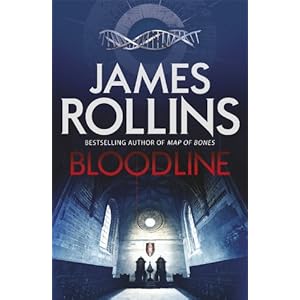
"Bloodline," by James Rollins

Creative Commons License
Stuff and Nonsense by Amy Cockram is licensed under a Creative Commons Attribution-Noncommercial-No Derivative Works 2.0 UK: England & Wales License.

My decision to borrow less from the library this year and catch up on my own shelves - and my review pile - has been going pathetically badly.  I'm trying to justify this to myself because my local library is due for redevelopment soon, and I'm making the most of the services before they become more restricted during building work.  My latest library temptation was the new James Rollins novel, as I have read and enjoyed other books in his SIGMA Force series.

In this novel, SIGMA are called in to rescue the pregnant daughter of the American president, who has been kidnapped from a yacht in the Seychelles.  She was travelling incognito with her husband - who was brutally killed - and Painter Crowe, the Director of SIGMA, suspects that there is more to the situation than they are being told.  Why were they travelling in secret?  Is there something nefarious going on in the elite fertility clinic in which Amanda was given the IVF treatment that resulted in her pregnancy?  And is The Guild, the secretive organisation that is the recurring enemy of SIGMA, involved in the kidnapping, as Painter suspects? 

The idea of dirty deeds in a fertility clinic exclusively casts women as its victims, and the plight of pregnant and vulnerable Amanda is effectively realised.  In my opinion, this is probably the darkest and most disturbing novel that James Rollins has written - but this feeling might be due to my gender, given the victimhood and powerlessness of some of the women in "Bloodline." However, it has to be said, that this is counterbalanced by Rollins in depicting Amanda, although physically vulnerable, as psychologically resilient and determined.  In addition to this, there are three strong women within SIGMA who resolutely refuse to become victims and are instrumental in bringing this storyline to its conclusion.  Nevertheless, I wouldn't recommend this novel to a woman contemplating fertility treatment.

James Rollins' novels never fail to be exciting, involving and achieve the goal of being effective thrillers.  In the SIGMA team he has created a well-developed collection of characters and, if he does ever decide to kill one off, every one would feel like a loss to the group.   On Goodreads I have given this 4 stars.  This might seem odd in comparison when I have given other, outwardly more literary, novels a lower star rating.  My justification for this is quite simple: within his chosen genre of writing - adventure with a semi / pseudo scientific or religious hook - James Rollins is one of the best writers around...

Sunday, 27 March 2011

Chris Kuzneski

Creative Commons License
Stuff and Nonsense by Amy Cockram is licensed under a Creative Commons Attribution-Noncommercial-No Derivative Works 2.0 UK: England & Wales License.

These kind of books are my shameful secret (amidst an ocean of the embarrassing tosh that I sometimes read). Chris Kuzneski's novels belong in an adventure genre that is part Indiana Jones, part Dan Brown. In this genre the plot normally revolves around chasing clues to find a pseudo-historical or pseudo-religious MacGuffin; the narrative takes its starting point from a historical or religious personage or story, and a fictional plot then develops around this central idea. This genre is great fun, but shouldn't be confused with historical account as some strangely deluded people seemed to do with Dan Brown's novels.

Chris has written a series of novels with the characters of Jonathan Payne and David Jones, ex military men from a fictional special forces team. Payne inherited a thriving business and a fortune from his grandfather, and was obliged by these family commitments to leave the military. His wealth allows him to set up his friend, Jones, as a private detective (in a nice line, Jones is described as a natural detective who, instead of worrying if a glass is half-full or half-empty, will try to "figure out who drank the damn water"). In the series of books they continue to find fantastical adventures, and Payne's wealth helps to facilitate jaunts to exotic places in search of treasure.

There are a couple of things that stand Chris Kuzneski apart from other writers in this kind of area that I have read (Dan Brown, Matthew Reilly, James Rollins), and the primary one is the sparky friendship that he has created between these two characters. He has written for them a strong and loyal friendship, but one that is created through their entertaining banter and repartee. This friendship rings true with some friendships I have had that have been based on a good-natured winding up of the other person.

Another thing that sets him apart is the story of his break into being a published writer. This is a story that should hopefully inspire writers and give them hope. His first novel - "The Plantation" - was ignored by agents and rejected by publishers. So he printed a number of copies from a print on demand company and sold them from the back of his car, as well as sending them on to authors he admired and asking them if they would read it (a number did, apparently - Lee Child, James Patterson, James Rollins - and were willing to endorse it). He was lucky enough that an agent bought a copy and wanted to take him on, who then sold his second book. "The Plantation" has now been officially published on the back of his success, although it might not be as easy to find as his subsequent novels (I think my copy might be an import).

Incidentally, Chris Kuzneski has his own Facebook page and, rather sweetly, each person who posts seems to get a personal response from him. He was impressed that I can brush my teeth and read at the same time (not the main thrust of my post, but the one he seemed to pick up on - if he thinks that is impressive, he should see me hold a book open with my toes so that I can read while drying my hair and eating breakfast as I get ready for work). I have also just realised that I referred to him earlier in this post as Chris - first name terms - when normally I find it hard to break the academic habit of using the author's surname. That might be a reflection on the fact that his Facebook page makes him seem more personally accessible and connected to his fan base, which is quite endearing (although his characters are quite tough, so he might not appreciate such girly adjectives as sweet or endearing).


If anyone is interested to read them, these are his novels, in order:
"The Plantation"
"Sign of the Cross"
"Sword of God"
"The Lost Throne"
"The Prophecy"
"The Secret Crown"

"The Plantation" is a bit different from the other books - it's darker, and I think due to its publication history does not tie in as part of a series as closely as the other books do (for example, Jonathan Payne has a girlfriend who he is willing to risk his life for, but who is then never acknowledged again in the following books). But in the main, it probably helps to read them in order as they do mention events in previous books. It might help, in modern terminology, to think of "Sign of the Cross" as a reboot.