Showing posts with label horror. Show all posts

Friday, 5 April 2013

"The Daylight Gate," by Jeanette Winterson

Creative Commons License
Stuff and Nonsense by Amy Cockram is licensed under a Creative Commons Attribution-Noncommercial-No Derivative Works 2.0 UK: England & Wales License.

In my last post I admitted to not having read very much Oscar Wilde and to neglecting the classics in general. In this post, I have to admit that I have read very little of Jeanette Winterson's writing. I think that I read "Oranges Are Not The Only Fruit" a long time ago, but nothing else since. And, to be honest, I am not sure that I would have found my way to reading this novel, had I not been loaned it by a friend and Hammer horror fan (this is published by Hammer).

In common with the last book that I read and reviewed on this blog, "Oscar Wilde and the Murders at Reading Gaol," Jeanette Winterson's novel takes its starting point from historical events.  In "The Daylight Gate," she takes real-life figures from historical records of the 1612 Trial of the Lancashire Witches - both the accused and the accusers - and weaves them into a fictional narrative. This was something that I know little about, but since reading this novel I have been finding out more about the history from this fascinating website.

Although I enjoyed the story and the historical background was interesting, I don't think that this has inspired me to seek out other novels by Jeanette Winterson. I do concede, though, that as I have not read much by her before I don't know how typical this novel is of her normal writing style.  I found that her prose was very bare - quite short sentences, to the point, with not much extraneous detail - and I think that it was probably too bare for my taste.  It's odd that the same friend who I borrowed this book from had also loaned me "The Woman in Black."  When I wrote about Susan Hill's ghost story here, I wrote that I found her descriptive writing hard to grip on to.  Curiously I found it hard to get a grip on Winterson's writing in this novel due to the paucity of description.  Just call me awkward; I'm sure my husband probably does.

I also felt that, although there are grim and gruesome parts of this book, it wasn't especially scary - and I did have the expectation that it would be because this was published by Hammer.  In this respect I felt that "The Woman in Black" was more effective, although I should admit that my limited horror reading does incline more towards the ghostly than the witchy (despite having called our cat Pyewacket, which is the name of a witch's familiar in a play I love called "Bell, Book and Candle").  One reason why I favoured "The Woman in Black" was that Susan Hill took us more into Arthur Kipps's fear, reactions and emotions - and fear can be incredibly catching - while Jeanette Winterson's sparse style seems to take the dictum of "show, don't tell" to extremis.  I didn't feel that I got much of a sense of the inner life of her characters - although the lesbian love story part of the novel was poignant and effective - and I wanted more insight into them.  

If you are interested in reading or watching something about witchcraft and history, I would be more inclined to recommend "Vinegar Tom" by Caryl Churchill.  This is a theatre work which I have never seen staged, but I remember reading and enjoying the script when I was at university.

Although this did not necessarily work for me, I am still intrigued to read more that has been published by Hammer and I do like a good ghost story.  In particular I am keen to get my hands on "The Greatcoat," by Helen Dunmore....

Wednesday, 31 October 2012

"The Woman in Black," by Susan Hill

Creative Commons License
Stuff and Nonsense by Amy Cockram is licensed under a Creative Commons Attribution-Noncommercial-No Derivative Works 2.0 UK: England & Wales License.

I finished reading "The Woman in Black" a couple of days ago, but I hadn't yet got around to writing a post about it.  I have a case of book burnout at the moment; I feel like I have lost my blogging mojo.  However, I just remembered that it is Hallowe'en tonight and so it would be fitting to put up this post now...

I was loaned this book by a friend, having - in a reversal of the normal way of things - seen the film first.  I knew that the ending of the novel is meant to be different from the play (which I haven't seen) and different again from the film, and the framing narrative made a significant factor in this difference obvious from the outset.  However, the set up for the story is the same: Arthur Kipps, a young solicitor, is sent to an isolated old house in a marsh to sort through the disordered paperwork of a deceased client.  Spooky stuff happens.

I find Susan Hill's prose style difficult, and I find it hard to explain why.  The experience of reading a page of her writing, for me, is rather like sliding at speed down a vertical glass wall, unable to find anything to grip on to and stall my descent.  I get to the end of a page and sometimes have to re-read it, finding that nothing has stuck.  It isn't that her style is particularly complex; more that her writing is quite descriptive.  It is a salutory exercise in what a lazy reader I have become, sliding over passages of description to get to dialogue or a development in the plot.  It is entirely a problem with me as a reader rather than her as a writer, which I think has been exacerbated by a reading diet of entertaining but not particularly challenging books.  I need to rectify this.

Once I'd got over this problem and managed to get a grip on her writing style, I enjoyed this book.  There is a peculiar skill in writing about things not happening: in prolonging the tension in the expectation of an event to an almost unbearable level, or in something happening in obscurity so that its significance isn't fully understood.  Susan Hill is particularly good at this, and also at another staple of the ghost story genre; making something familiar into something strange and threatening.

In addition, I realised that the ghost story in writing can cope with one of the problems of the ghost story/horror genre better than film can, by which I mean the occasionally stupidity of characters that, when I'm watching a horror film, leaves me shouting at the screen "No, you idiot, why would you want to go in there?" (or words to that effect)*.  I felt that "The Woman in Black" excels at taking you inside the thought processes of Arthur so that, instead of wondering why he does something, you can understand his initial denial, the rationale for his actions, and his attempts to master his mounting fear.  I think that the first person narrative works particularly well in ghost stories - the stories of M.R. James are the epitome of this - because they take you into the fear that the protagonist experiences and invite you to share in it.  When Arthur is scared, Susan Hill takes you into his physical and emotional reactions as the person experiencing them and not as a distanced third person observer.

This novel - along with "Howard's End is on the Landing" - has gone some way to get me over my SusanHillophobia (which I think had its roots in having to read "Strange Meeting" at school) to the extent that I looked for her other ghost story novellas when I was last in the library.  Sadly they didn't have any on the shelves.  Maybe I should pick "Florence and Giles" by John Harding as a further Hallowe'en read?  Or you can't go wrong with an M.R. James ghost story....

*The brilliant Eddie Izzard does a brilliant routine about this problem which I just rediscovered on Youtube, which you can watch here.

Sunday, 16 September 2012

"The Haunting of Hill House," by Shirley Jackson

Creative Commons License
Stuff and Nonsense by Amy Cockram is licensed under a Creative Commons Attribution-Noncommercial-No Derivative Works 2.0 UK: England & Wales License.

I picked up this book from the library on a whim because it is such a classic of the horror genre.  I have big pile of books to read at the moment, and I almost decided to take this one back unread.  However, once I read this brilliant first paragraph, I was hooked and had to read it:
No live organism can continue for long to exist sanely under conditions of absolute reality; even larks and katydids are supposed, by some, to dream.  Hill House, not sane, stood by itself against its hills, holding darkness within; it had stood so for eighty years and might stand for eighty more.  Within, walls continued upright, bricks met neatly, floors were firm, and doors were sensibly shut; silence lay steadily against the wood and stone of Hill House, and whatever walked there, walked alone.
 In "The Haunting of Hill House," Dr Montague invites a disparate selection of people to a supposedly haunted house.  The one thing they all have in common is that he believes that they might have some level of psychic ability.  Many of those invited don't turn up, but Eleanor does (who was connected to supposed poltergeist activity when she was 12), as does Theodora, who had showed some psychic ability in a laboratory experiment conducted by the doctor.  They are also joined by Luke, who isn't supposed to be psychic but is there as a representative of the family who owns the house. Of course, there are nefarious and dark deeds contained within Hill House's upright walls - and the experiment is darker than Dr Montague had imagined.

When I started reading this book, it occurred to me early on to check the date when it was published (1959).  It is unusual for me to do this - in the main, the books I read are comparatively recent - but I wondered when it was written in terms of the genealogy of the haunted house genre.  My awareness of this date also meant that I began to read it in terms of what I knew of McCarthyism, conformity and the repressive fifties in America.  It's an interesting way to read the book, and especially the interaction between Eleanor (conformist, quieter, always worried by how others see her and paranoid that she is being mocked) and Theodora (more a free-spirit, a new woman, self-possessed but also self-obsessed).  On the cusp of a new decade, Eleanor seemed to represent the old oppressions of society while Theodora was looking to a future of new freedoms.

This is more a horror novel of creeping dread and suggestion than gore which, as a wimpish reader of horror, is how I prefer it.  I read Jackson's novel as essentially a twofold character study.  The first character that Shirley Jackson focuses on is Eleanor, who is a study in downtrodden introversion.  Her life was given over to caring for her ailing, demanding mother and, since her mother's death, she has been living with an equally domineering sister and brother-in-law.  Her life has constantly been on hold to others, and she is a dispossessed character with no home of her own and no secure sense of self.  The other central character is that of the malevolent house itself, which seems to react to its new inhabitants and manipulate them.

Shirley Jackson's novel has been adapted for film twice under the title "The Haunting" - the most recent with Liam Neeson as the doctor - and, in the normal way of these things, the book is much, much better.  If you have seen the film and not been impressed, please don't be put off reading the book.  if you like ghost stories, it's definitely worth it.  

Wednesday, 18 July 2012

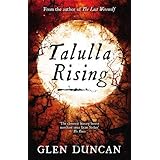
"Talulla Rising," by Glen Duncan

Creative Commons License
Stuff and Nonsense by Amy Cockram is licensed under a Creative Commons Attribution-Noncommercial-No Derivative Works 2.0 UK: England & Wales License.

 I enjoyed reading Glen Duncan's "The Last Werewolf" so I was happy to get hold of the sequel, "Talulla Rising," from the library.

In setting up the start of "Talulla Rising" in the next paragraph, I will give away a bit of the end of the first novel.  If you have not yet read "The Last Werewolf" but think that you might, I suggest that you skip the next paragraph if you want to avoid a spoiler.

At the end of "The Last Werewolf," Talulla's lover, Jake (also a werewolf), has been killed and Talulla has just found out that she is pregnant (which she had thought to be impossible).  The sequel starts as Talulla is in hiding from WOCOP (World Organisation for the Control of Occult Phenomena), and has acquired an unlikely birthing partner in the figure of Cloquet (who had tried to kill Jake in the first book).  The birth is a catalyst for a quest during which Talulla acquires both new allies - including a new lover - and new enemies, and werewolf once again clashes with both humans and vampires.

I think I might actually have preferred this book to the first although, from other opinions that I have heard, I might be in the minority on this.  I liked Jake's voice in the first book - and I know others have said how much they miss him - but I liked the new character of Walker, and I also enjoyed Talulla's voice.  It has started me thinking more about how effective it is  - or isn't - when an author adopts the persona of someone of the opposite sex.  Does it make a difference to the way I read something?  Certainly in this novel I sometimes found myself taking a mental step back - particularly when he was writing about experiences such as childbirth that are specific to the female body - and remembering the male author behind the character.  I don't think it is a fault of his writing; if anything, I was most aware of it when I felt he wrote something particularly effectively.  This is a reaction that is very personal to me and, now that I have become aware of my reaction, it will be interesting to think through that response in my future reading.  Why should it feel any different to me than, say, an author who has never killed writing in the persona of a murderer?  Both are acts of imagination. I suspect the answer to this should be that it isn't any different.

Aside from the fact that I struggled with an aspect of the internal logic to this novel, which I wrote about here, I am still enjoying this series of novels and am looking forward to the last in the trilogy.  I found myself being torn in two one night, because I felt tired and very badly wanted to go to sleep and yet I just as badly wanted to read on.  I don't think that there is a greater compliment than that to a book or author.

Sunday, 8 July 2012

I've started reading "Talulla Rising"....

Creative Commons License
Stuff and Nonsense by Amy Cockram is licensed under a Creative Commons Attribution-Noncommercial-No Derivative Works 2.0 UK: England & Wales License.

Product DetailsA few posts ago I read "The Last Werewolf" by Glen Duncan, and I wrote about it here and took part in the discussion panel on "The Readers" podcast.  I'm now reading "Talulla Rising," the next in the trilogy, and I'm still finding the narrative compelling.  However, there is something bugging me....

(spoiler ahoy) 

At the start of the second book, Talulla gives birth to twins who are also werewolves.  Now Glen Duncan has already established that, once a person has been bitten and becomes a werewolf, they don't age.  So does that mean that the twins will be forever babies?

Of course it's fiction and of course werewolves don't exist, but there is still a potential logical loophole there that is playing on my mind.  If sure you can argue that all bets are off if a child is born of two werewolves - which might well be the way that Duncan will go with this, as there isn't really anywhere you can go with the characters if Lorcan and Zoe never get beyond the screaming and puking stage - but I can't put away this niggling idea.  That's probably my OCD side manifesting.

If someone knows something I don't about the werewolf myth in literature that gives him a get-out clause on this, please let me know.

Thursday, 21 June 2012

"The Grin of the Dark," by Ramsey Campbell

Creative Commons License
Stuff and Nonsense by Amy Cockram is licensed under a Creative Commons Attribution-Noncommercial-No Derivative Works 2.0 UK: England & Wales License.

A few months back, I discovered a list on the internet entitled "The 25 Best Horror Novels of the New Millennium."  It was an interesting list, some of which I have read ("Horns") and others that were new to me.  There were two that I really liked the sound of: Ramsey Campbell's "The Grin of the Dark" and "Drood" by Dan Simmons.  I went to find them at my local library.  "Drood, " I discovered, is a big book so I decided I would need to leave that for when I have more time, but I borrowed the Ramsey Campbell.

"The Grin of the Dark" is narrated by Simon Lester, a film graduate who is working in a petrol station following a disastrous association with a film magazine that got sued after a colleague wrote a scurrilous article.  Simon is visited at work by a lecturer from university who offers him the opportunity to write a book for a newly started university press.  His subject will be a reworking of his thesis about forgotten talents of the cinema.  One of these, who becomes the focus of his research, is a silent film comedian called Tubby Thackeray whose live performances and films were said to have driven people mad.  This quest becomes an obsession.

This book reminded me of an incident quite a few years back.  I had been to Buckfast Abbey with a (now ex) boyfriend, and in a book in the gift shop I discovered that the grave of Squire Richard Cabell was in a church nearby.  I have loved the myths and legends of Dartmoor since I was young, and I love literature, and Richard Cabell is the intersection of this: he is the debauched landowner of legend on whom Sir Arthur Conan Doyle allegedly based the figure of Sir Hugo Baskerville.  He was thought to be so evil that his grave has bars around it, supposedly because people were afraid that he would be able to escape after death.  I wanted to see this, so we went to the church on the way home.  The grave itself is creepy - I remember that there was a pattern of three or four parallel rust marks on the wall, which, to me, looked like clawed fingermarks of someone trying to excape - but it has nothing on the church.  I hadn't realised before going there that the church was a ruin, and I discovered afterwards that it was ruined by a fire which was supposedly started by satanists.  I think of myself as being as far from psychic as it is possible to be, and I am pretty much impervious to atmosphere; I think I'm quite a realistic person and things like that pass me by, but my ex got freaked out by the place - some of which rubbed off on me - and he wanted to leave very quickly.

The experience of Ramsey Campbell's novel has made me think of this incident a couple of times in the past week.  Campbell's novel is not gory at all, but it is unsettling; it is like being with someone who gets the wiggins over something and being infected by their unease.  There are some very effective set pieces - a night-time visit to a derelict theatre in which Tubby had performed sticks in my mind - and some eldritch Lovecraftian ideas.  There are elements of this novel about which I feel very divided; his use of word-play and the disintegration of language is interesting and unsettling, but sometimes feels a bit laboured.  I did think that some of the imagery was occasionally overused, but the ending - which I read late one evening, when my husband was away overnight - still managed to unsettle me and left me feeling jumpy when I heard my neighbour moving about, or when a saucepan settled on the draining board in the kitchen.  

I normally hate open-ended books, but paradoxically one thing that I liked about this book was its ambiguity.  There is much that is left unexplained and open to interpretation, which serves to make it even more haunting.  There is a short epilogue which does make a couple of plot elements more explicit, and I would even go so far as to say that I would have preferred not to have read this: the ending of the chapter before would have made a macabre and memorable final image to finish the novel.  It isn't terrifying, but it is insidiously creepy.

I'd not read any Ramsey Campbell before, so this was an interesting discovery and I might decide to pick up another of his novels in the future.....

Thursday, 10 May 2012

"The Last Werewolf," by Glen Duncan

Creative Commons License
Stuff and Nonsense by Amy Cockram is licensed under a Creative Commons Attribution-Noncommercial-No Derivative Works 2.0 UK: England & Wales License.

Life, like the boring drunk at the office party, keeps seeking you out, leaning on you, killing you with pointless yarns and laughing bad-breathed in your face at its own unfunny jokes.

I'm a little bit early with this post, but I wanted to get it written while it was still fresh in my mind; early because this is the one of the choices of The Readers Summer Book Club and it isn't up for discussion yet.  The Readers podcast - if you haven't already discovered it and, if you haven't, you really should check it out - is a very entertaining UK based podcast about books.  This is one of a few podcasts that I look forward to every week (along with the Mark Kermode and Simon Mayo movies podcast and, of course, the podcasts that my husband is on), and it is available from the link above and also on I-Tunes.  I'd heartily recommend it.  The Bookrageous podcast is also good but, as this is US based, I've occasionally been frustrated when they have talked about books that sound great but don't seem to be readily available in the UK.

Anyway, I already had "The Last Werewolf" on my list of books to read since hearing about it on the Bookrageous podcast - and, by coincidence, I had already borrowed it from the library when I heard that it was one of the book club picks. 

Glen Duncan's anti-hero is Jacob Marlowe.  Jake is just over two hundred years old, and for one hundred and sixty-seven of those years he has turned into a werewolf at every full moon.  And Jake is a marked werewolf, as the incredibly successful attempts of WOCOP (World Organisation for the Control of Occult Phenomena) to eradicate werewolves mean that he is the last one left.  Jake has been managing to evade them, but they seem to be catching up with him, and he seems to have also attracted the attention of some vampires (which is odd as they normally revile werewolves).  In addition, "The Last Werewolf" is also partly a love/lust story, with a strong wolfish libido, so you would be advised not to buy this book for an easily shocked maiden aunt as a present. 

What sets this book apart from the glut of other vampire and werewolf novels, is Duncan's use of language.  I haven't read any of his other novels, but I gather that Duncan is an established, although previously not incredibly famous, "literary" writer.  Duncan's novel is mostly first person in Jake's voice, and I found Jake to be a very articulate and entertaining narrator.  In a nice touch, I found myself occasionally aware of little elements of ever-so-slightly archaic sounding language that seem fitting for a narrator who has been on the earth for such a length of time.  A couple of quotes which I loved have popped up in my Facebook timeline when I wanted to share them with friends (cars stopped by snow are "poignantly stupefied").  I rarely feel moved to quote from books in this way but when you discover an insult as brilliant as "pug-faced lolloper," you just have to share it. 

This magnificent insult also beings me to another thing I love about this book - yes, it is dark, but it has some wonderful moments of black humour sprinkled through the narrative.     I was particularly fond of an early passing reference to Jake having "eaten a forty-three-year-old hedge fund specialist."  I'm not sure why I found this funny - perhaps the specificity of the age, the profession; the matter of fact and mundane way this is mentioned - but when I reached this on page 5, I knew that I was probably going to enjoy this book.

Duncan's take on vampires is different from the kitsch, glittery, costume-jewellery vampires of Stephenie Meyer (thank heavens), and the werewolf is a dangerous, primal creature and not just a hunky man who every so often ends up naked in the woods.  There is another quote that I put on Facebook, so my friends on there might recognise it, which I found amusing.  I'm torn because I don't want to include it here - it's not a plot spoiler, but it is an ideological spoiler - but I want to re-quote it because I love it.  My solution to this is that I will quote it in the first comment on this post - if you are planning to read the book and don't want a funny couple of lines to be spoiled, then don't read the first comment.  Even if you are planning to read this book and do read this quote, there is a lot more to Glen Duncan's vampires than this quote might suggest.

"The Last Werewolf" is apparently the first in a trilogy.  The second in the series, "Talulla Rising," is now out, but my local library doesn't seem to have a copy (which is a form of torture for a committed bibliophile).  I'm considering buying it, and my willpower might yet wane when it comes to the next full moon...

Saturday, 11 February 2012

"The Dunwich Horror," by H.P. Lovecraft

Creative Commons License
Stuff and Nonsense by Amy Cockram is licensed under a Creative Commons Attribution-Noncommercial-No Derivative Works 2.0 UK: England & Wales License.

When I mentioned a while ago that H.P. Lovecraft was a gap in my reading that I fancied exploring, I was loaned a copy of "The Dunwich Horror" by Beth of the excellent blogs "Upward Spiral" and "Things I Wish They'd Told Me."  As part of my wider New Year's Resolution to take control of my reading, I thought I'd start by reading books that I have borrowed and hadn't got around to yet - so I started with this one.

This is a collection of short stories - unusual for me, as I read few short stories and tend to prefer novels - which comprises the following stories:
  • The titular story, "The Dunwich Horror"
  • "The Dreams in the Witch House"
  • "The Lurking Fear"
  • "The Thing on the Doorstep"
  • "Hypnos"
  • "The Outsider"
    "The Dunwich Horror" is probably the most substantial story in the collection in terms of length and the uncanny, while the later stories are shorter but still effectively creepy.

      The first story, "The Dunwich Horror," starts with some description of the country around Dunwich, and I found Lovecraft's description of nature particularly interesting.  Lovecraft's landscapes are paradoxically unnatural: nature is heightened and strange, claustrophobic and off-kilter.  The world of Lovecraft is a liminal one that is impinged upon by "elder things" who used to populate the earth and want to find a gateway back to reclaim their territory, or unknowable things from other dimensions which are discovered by men who covet forbidden knowledge: nature hides strange secrets.  His stories of old creatures beyond our imagining create a hind-brain unease; a primal fear of things unknown and unknowable: there are more things in heaven and earth than are dreamt of in our philosophy.

      I found his stories more unsettling than I did terrifying, which suits me as I am too much of a wimp for terrifying.  Another thing: unsettling haunts for longer than terror, in the same way that cold, considered bitterness can strike at the heart more than the passing heat of impulsive anger. Lovecraft's stories create a state of unease by suggestion and creeping dread more than explicit description - and, when he does try to describe his horrors, he tries to put their strangeness beyond the reach of language.   In particular "The Lurking Fear" has a striking moment when the speech of one of his characters descends into hysterical, purple prose where madness overtakes sense. The best horror films build a sense of menace before showing the monster - it's interesting to think how horror works in writing compared to film, as it is such a visual genre - and Lovecraft's strength seemed to me to be in creating a smothering atmosphere of menace and dawning comprehension.

      His stories engaged my mind and my imagination to an extent that had me dragging down my old university reference books to find out more about him and his writing - a dangerous enterprise, as it started a bookslide on my over-stuffed bookcase - which is something I haven't felt compelled to do for a while.  He seemed sadly overlooked by my encyclopaedias of literature, so I resorted to Wikipedia (sorry). This intrigued me more, particularly the story of his unhappy and ill-fated marriage as I wondered how much this had inspired the twisted depiction of the marriage in "The Thing on the Doorstep."  This was always one of my failings as an academic: my tendency to be interested in deeply unfashionable and questionable biographical criticism.  As far as I am concerned, the author is far from dead: the mind that creates a world of imagination can be as fascinating as the work itself.

      I found H.P. Lovecraft fascinating so far: it's not like anything that I have ever read before.  I'm not a big reader of horror - being of a nervous and impressionable disposition - and my excursions into it so far have been restricted to Victorian ghost stories, vampire novels, Joe Hill's fiction and a few Stephen King novels (a Lovecraft fan, as I think is Joe Hill).  I've realised that Lovecraft is now out of copyright, so I have downloaded the few of his stories that I could get from Gutenberg for future reading.

      Friday, 16 July 2010

      On giving up

      Creative Commons License
      Stuff and Nonsense by Amy Cockram is licensed under a Creative Commons Attribution-Noncommercial-No Derivative Works 2.0 UK: England & Wales License.

      It used to be that I would never give up on a book that I have started. Once I began to read something I felt duty bound to finish it, even if I wasn't enjoying it.

      That isn't the case so much any more. Now that I am a bit older and have so many books and so little time, I have decided that I won't force my way through a book if I am not enjoying it. It isn't worth it. I do sometimes make exceptions for something that is 'worthy;'a book that is considered to be a classic, or a book that is highly regarded and intelligent.

      There are, however, remnants of my own pride and stubbornness which mean that giving up on a book is something that I don't do lightly. But, I confess, I am considering giving up on "The Strain."

      I don't mean to imply that "The Strain" is a bad book. It is an interesting take on the idea of the vampire, which is intelligently written by Guillermo Del Toro and Hulk Hogan (sorry, Chuck Hogan). The opening of the novel is particularly tense, and they effectively create an atmosphere of suspense and foreboding. But I am considering giving up on it because it is simply too damn scary for a wimp like me.

      I'm not good at horror, and I am especially bad at body horror - and this is quite body horror-y. I am a hypochondriac who is scared by her body's own potential for betrayal: for its potential to act against the dictates of my will, from the big stuff like cancer or heart attack, to the small stuff like not being able to resist the need to fart when in a public place. As someone who imagined she had bubonic plague after learning about it at school and who still can't watch the whole of the "Ice" episode of "The X-Files," "The Strain" is a bit too virus-y/parasite-y for my liking.

      "The Strain" is the first book in a trilogy. Is it a good book? It probably is - if it was a bad book, I wouldn't be so freaked out by it. If a book in the horror genre scares you, then surely that makes it a success. Will I finish reading it? I'm not sure yet. Will I read the next two books? Probably not.

      Sunday, 4 July 2010

      Book review: "Horns," by Joe Hill

      Creative Commons License
      Stuff and Nonsense by Amy Cockram is licensed under a Creative Commons Attribution-Noncommercial-No Derivative Works 2.0 UK: England & Wales License.

      "Ignatius Martin Perrish spent the night drunk and doing terrible things. He woke the next morning with a headache, put his hands to his temples, and felt something unfamiliar, a pair of knobby pointed protuberances. He was so ill - wet-eyed and weak - he didn't think anything of it at first, was too hungover for thinking or worry.
      But when he was swaying above the toilet, he glanced at himself in the mirror over the sink and saw he had grown horns while he slept. He lurched in surprise, and for the second time in twelve hours he pissed on his feet."

      Joe Hill's book, "Horns," invokes sympathy for the devil. In his recent past Ig Perrish was a happy young man, with a beautiful girlfriend whom he met at a local church. He was due to go to London to start his dream job. Then his girlfriend dies tragically and violently the night before he is due to go away, and Ig is the main suspect. The case against him collapses, but so has his happiness, and Ig is left with a joyless and directionless life.

      Then Ig wakes with the titular horns and he discovers a new talent: people start to confess their deepest, darkest desires to him. The emphasis here is on the darkness; these are things that you don't even like to admit to yourself. He also finds that he can influence people to act upon these desires. Ig is disturbed to discover what his family, friends and acquaintances think of him and, even more significantly, he discovers what really happened on the night his girlfriend was killed. He then starts to direct his new talents towards revenge.

      Joe Hill is Stephen King's son, and there are similarities in their writing. If you enjoy Stephen King, you will probably enjoy Joe Hill as well. They share a robust and direct writing style; their prose is functional rather than flowery. However, I have been about 100 pages into a Stephen King book before now - 100 very enjoyable pages - before realising that actually nothing much has happened. This is not Joe Hill's style; he is more a mastery of brevity and, as the opening extract demonstrates, he jumps straight into the story.

      Joe Hill, like his father, is aware of the darkness within the heart of man. His characters are deeply flawed and often quite unsympathetic. In "Horns," as in "Heart-shaped Box" (his first novel), I found the female characters more likeable than the male. However, this comes with a huge caveat; his female characters, though more sympathetic, are often victims of abuse and/or their own self-hatred.

      I'm becoming aware that I am not exactly selling this book, and I'm probably making it sound heavier than it is. Yes, there is a streak of morality in Joe Hill's writing, but there is also a pleasing ambiguity between good and bad, human and demon. He has a nice line in black humour that lurks in the dark shadows of his writing. Particularly in "Heart-shaped Box," which I probably enjoyed even more than "Horns," Joe Hill's imagery provides some startlingly vivid, creepy, details, and his characters are memorable and well-defined.

      I also noticed on IMBD that a film of "Heart-shaped Box" is in development. If the film gets made - and I hope it does - I would be interested to see who is cast, and how Hollywood treats Joe Hill's novel.

      I read "Heart-shaped Box" because I was intrigued to read a book by Stephen King's son. Now I read his books because they are by Joe Hill.

      By the way, Alicia and anyone else who is scared of snakes. "Horns" is probably one you should avoid.