Thursday, 19 July 2012

"The Dead Won't Sleep," by Anna Smith

Creative Commons License
Stuff and Nonsense by Amy Cockram is licensed under a Creative Commons Attribution-Noncommercial-No Derivative Works 2.0 UK: England & Wales License.

After being briefly distracted by books about pubs or werewolves, I decided to return to the books in my pile of review copies.  I thought that I would revisit my primary genre of choice - crime.

Anna Smith's novel is set in urban Glasgow.  It is an unusual read for me: I tend to prefer the mystery and detection sub-genre of crime, and Anna Smith starts the novel "Columbo" style by showing us the insalubrious circumstances of a young girl's death.  This isn't a whodunnit - instead Smith's plot hinges on the efforts of dogged, dedicated journalist Rosie Gilmour to expose the corruption behind the crime and on the lengths the perpetrators go to in order to conceal their role in her fate.

By rights, I shouldn't have liked this book - but I did.  I prefer the mental challenges of a whodunnit to the action of a thriller, and yet I still enjoyed this.  I don't tend to like gritty realism in my reading.  If I want depressing realism, I can watch the news or read true crime (which I personally dislike as it creeps me out and, to me, feels morally suspect and borderline exploitative).  I read to be entertained and to escape, so the brittle, hard-edged urban world of prostitution and drugs in Smith's novel should have put me off - yet it didn't.

Here's the main reason I enjoyed the novel despite the reasons why I expected not to be drawn in - Rosie Gilmour.  Smith's main character is engaging, vulnerable yet determined, and I cared what happened to her.  There is a fragile, burgeoning romance in the novel and I was behind Rosie all the way in wanting things to work out for her (I won't give away the outcome).

I have discovered that there is a further book by Anna Smith featuring Rosie Gilmour - "To Tell the Truth" - which I am eager to get my hands on so that I can find out what Rosie did next.

Thank you to Quercus Books for sending me a review copy of this book.  It took me a while to get the chance to catch up on reading it, but I am glad that I did.

Wednesday, 18 July 2012

"Talulla Rising," by Glen Duncan

Creative Commons License
Stuff and Nonsense by Amy Cockram is licensed under a Creative Commons Attribution-Noncommercial-No Derivative Works 2.0 UK: England & Wales License.

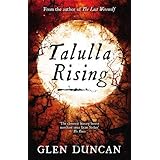
 I enjoyed reading Glen Duncan's "The Last Werewolf" so I was happy to get hold of the sequel, "Talulla Rising," from the library.

In setting up the start of "Talulla Rising" in the next paragraph, I will give away a bit of the end of the first novel.  If you have not yet read "The Last Werewolf" but think that you might, I suggest that you skip the next paragraph if you want to avoid a spoiler.

At the end of "The Last Werewolf," Talulla's lover, Jake (also a werewolf), has been killed and Talulla has just found out that she is pregnant (which she had thought to be impossible).  The sequel starts as Talulla is in hiding from WOCOP (World Organisation for the Control of Occult Phenomena), and has acquired an unlikely birthing partner in the figure of Cloquet (who had tried to kill Jake in the first book).  The birth is a catalyst for a quest during which Talulla acquires both new allies - including a new lover - and new enemies, and werewolf once again clashes with both humans and vampires.

I think I might actually have preferred this book to the first although, from other opinions that I have heard, I might be in the minority on this.  I liked Jake's voice in the first book - and I know others have said how much they miss him - but I liked the new character of Walker, and I also enjoyed Talulla's voice.  It has started me thinking more about how effective it is  - or isn't - when an author adopts the persona of someone of the opposite sex.  Does it make a difference to the way I read something?  Certainly in this novel I sometimes found myself taking a mental step back - particularly when he was writing about experiences such as childbirth that are specific to the female body - and remembering the male author behind the character.  I don't think it is a fault of his writing; if anything, I was most aware of it when I felt he wrote something particularly effectively.  This is a reaction that is very personal to me and, now that I have become aware of my reaction, it will be interesting to think through that response in my future reading.  Why should it feel any different to me than, say, an author who has never killed writing in the persona of a murderer?  Both are acts of imagination. I suspect the answer to this should be that it isn't any different.

Aside from the fact that I struggled with an aspect of the internal logic to this novel, which I wrote about here, I am still enjoying this series of novels and am looking forward to the last in the trilogy.  I found myself being torn in two one night, because I felt tired and very badly wanted to go to sleep and yet I just as badly wanted to read on.  I don't think that there is a greater compliment than that to a book or author.

Sunday, 8 July 2012

"The Longest Crawl," by Ian Marchant

Creative Commons License
Stuff and Nonsense by Amy Cockram is licensed under a Creative Commons Attribution-Noncommercial-No Derivative Works 2.0 UK: England & Wales License.

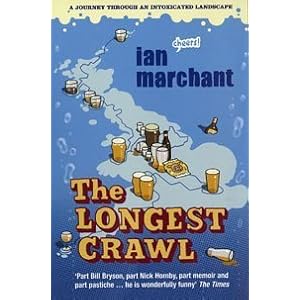
Longest CrawlI found this book for a couple of pounds in The Works (ssh, don't tell the author), and I bought it on impulse because I know a couple of places mentioned in the blurb on the back.

In "The Longest Crawl," Ian Marchant decides to go on a pub crawl for the length of Britain.  And I don't just mean Land's End to John O' Groats, no, that's for amateurs, I mean from the Scilly Isles to Unst in the Shetlands.  He is inspired by G.K. Chesterton's poem "The Rolling English Road" and the idea that the traveller's geography of the UK is inextricably tied to our heritage as a drinking nation.  He takes his friend, Perry, along with him as travelling companion for his month of driving, alcohol and hangovers.

I particularly liked the couple of bits about places I know, which intersected with some of my interests, and, as he travels the length of the UK, chances are that he might also write about somewhere you know and love.  In Plymouth he and Perry go to Prete's ice cream bar, where they are dumbfounded by a Robert Lenkiewicz mural on the wall.  I love Lenkiewicz's work, although I'm ashamed to say I have never been in Prete's, and I could easily highjack this post writing about him (how I saw Lenkiewicz in Plymouth a couple of times but was too intimidated to speak to him; how the dilapidated state of his huge outdoor mural on the Barbican saddens me; how I'd love to see The Riddle Mural at Port Eliot; how if I get rich I would like to own one of his paintings but it will need to be in a room my husband doesn't often go in because he's not keen on his work ).  He goes to Bath - a place I love - and mentions the Natural Theatre Company who I also shouldn't get started on (how I loved their touring shows when I was a teenager and wrote a couple of fan letters; how thanks to them I have a signed photograph of Henry VIII which I am fairly sure is a fake).  These familiar references are a big joy of the book.

In Marchant's book you learn quite a lot about the author himself, as well as learning a lot about the processes of making alcohol (Plymouth Gin, somerset cider, beer).   He is very self-deprecating and plays on the pub-bore side of his personality (without being boring): while his friend Perry flirts with cute barmaids and tour guides, he is the one asking technical questions about brewing and fermenting.  He is funny and frequently quite politically incorrect (with, I think, no malice), and he is very thoughtful along the way about the UK's historically fraught relationship with the demon drink

He also has a nice line in snoring similes ("like a donkey with emphysema" "like a dinosaur gargling wallpaper past").  But it's hard to beat the simplicity of my Dad telling my Mum that she snores like "an enraged warthog" (rude), or Mark telling me on various nights of the same cold that I made sounds in my sleep like "a startled baby otter" or, my personal favourite, a "disconsolate elk".

This was an interesting and entertaining book.  I'm thinking of getting one of Ian Marchant's earlier books "Parallel Lines," about our railways, as a present for my father who is a bit of a train fanatic.  Ssh, don't tell my Dad.

I've started reading "Talulla Rising"....

Creative Commons License
Stuff and Nonsense by Amy Cockram is licensed under a Creative Commons Attribution-Noncommercial-No Derivative Works 2.0 UK: England & Wales License.

Product DetailsA few posts ago I read "The Last Werewolf" by Glen Duncan, and I wrote about it here and took part in the discussion panel on "The Readers" podcast.  I'm now reading "Talulla Rising," the next in the trilogy, and I'm still finding the narrative compelling.  However, there is something bugging me....

(spoiler ahoy) 

At the start of the second book, Talulla gives birth to twins who are also werewolves.  Now Glen Duncan has already established that, once a person has been bitten and becomes a werewolf, they don't age.  So does that mean that the twins will be forever babies?

Of course it's fiction and of course werewolves don't exist, but there is still a potential logical loophole there that is playing on my mind.  If sure you can argue that all bets are off if a child is born of two werewolves - which might well be the way that Duncan will go with this, as there isn't really anywhere you can go with the characters if Lorcan and Zoe never get beyond the screaming and puking stage - but I can't put away this niggling idea.  That's probably my OCD side manifesting.

If someone knows something I don't about the werewolf myth in literature that gives him a get-out clause on this, please let me know.

Friday, 6 July 2012

I've been interviewed!

Creative Commons License
Stuff and Nonsense by Amy Cockram is licensed under a Creative Commons Attribution-Noncommercial-No Derivative Works 2.0 UK: England & Wales License.

A few weeks ago I was honoured when a friend of mine asked if she could interview me for her blog.  Annalisa is a writer with whom I was at 6th form college, and she has an excellent blog about writing called "Wake Up, Eat, Write, Sleep" (which sounds like a good life to have, apart from the waking up bit which I am not so keen on).

Her interview with me can be found here.

If you do pop to her blog to have a read of my interview, it would be well worth exploring some of the great posts that she has written previously to get to know her a bit better....

Thursday, 21 June 2012

"The Grin of the Dark," by Ramsey Campbell

Creative Commons License
Stuff and Nonsense by Amy Cockram is licensed under a Creative Commons Attribution-Noncommercial-No Derivative Works 2.0 UK: England & Wales License.

A few months back, I discovered a list on the internet entitled "The 25 Best Horror Novels of the New Millennium."  It was an interesting list, some of which I have read ("Horns") and others that were new to me.  There were two that I really liked the sound of: Ramsey Campbell's "The Grin of the Dark" and "Drood" by Dan Simmons.  I went to find them at my local library.  "Drood, " I discovered, is a big book so I decided I would need to leave that for when I have more time, but I borrowed the Ramsey Campbell.

"The Grin of the Dark" is narrated by Simon Lester, a film graduate who is working in a petrol station following a disastrous association with a film magazine that got sued after a colleague wrote a scurrilous article.  Simon is visited at work by a lecturer from university who offers him the opportunity to write a book for a newly started university press.  His subject will be a reworking of his thesis about forgotten talents of the cinema.  One of these, who becomes the focus of his research, is a silent film comedian called Tubby Thackeray whose live performances and films were said to have driven people mad.  This quest becomes an obsession.

This book reminded me of an incident quite a few years back.  I had been to Buckfast Abbey with a (now ex) boyfriend, and in a book in the gift shop I discovered that the grave of Squire Richard Cabell was in a church nearby.  I have loved the myths and legends of Dartmoor since I was young, and I love literature, and Richard Cabell is the intersection of this: he is the debauched landowner of legend on whom Sir Arthur Conan Doyle allegedly based the figure of Sir Hugo Baskerville.  He was thought to be so evil that his grave has bars around it, supposedly because people were afraid that he would be able to escape after death.  I wanted to see this, so we went to the church on the way home.  The grave itself is creepy - I remember that there was a pattern of three or four parallel rust marks on the wall, which, to me, looked like clawed fingermarks of someone trying to excape - but it has nothing on the church.  I hadn't realised before going there that the church was a ruin, and I discovered afterwards that it was ruined by a fire which was supposedly started by satanists.  I think of myself as being as far from psychic as it is possible to be, and I am pretty much impervious to atmosphere; I think I'm quite a realistic person and things like that pass me by, but my ex got freaked out by the place - some of which rubbed off on me - and he wanted to leave very quickly.

The experience of Ramsey Campbell's novel has made me think of this incident a couple of times in the past week.  Campbell's novel is not gory at all, but it is unsettling; it is like being with someone who gets the wiggins over something and being infected by their unease.  There are some very effective set pieces - a night-time visit to a derelict theatre in which Tubby had performed sticks in my mind - and some eldritch Lovecraftian ideas.  There are elements of this novel about which I feel very divided; his use of word-play and the disintegration of language is interesting and unsettling, but sometimes feels a bit laboured.  I did think that some of the imagery was occasionally overused, but the ending - which I read late one evening, when my husband was away overnight - still managed to unsettle me and left me feeling jumpy when I heard my neighbour moving about, or when a saucepan settled on the draining board in the kitchen.  

I normally hate open-ended books, but paradoxically one thing that I liked about this book was its ambiguity.  There is much that is left unexplained and open to interpretation, which serves to make it even more haunting.  There is a short epilogue which does make a couple of plot elements more explicit, and I would even go so far as to say that I would have preferred not to have read this: the ending of the chapter before would have made a macabre and memorable final image to finish the novel.  It isn't terrifying, but it is insidiously creepy.

I'd not read any Ramsey Campbell before, so this was an interesting discovery and I might decide to pick up another of his novels in the future.....

Saturday, 16 June 2012

"Oliver Twist" by Charles Dickens

Creative Commons License
Stuff and Nonsense by Amy Cockram is licensed under a Creative Commons Attribution-Noncommercial-No Derivative Works 2.0 UK: England & Wales License.

My husband has recently done a podcast on "Oliver Twist" which is on ITunes (look for Nerdology UK) or you can listen to it here.  I'm working up to joining in with one of his podcasts - in an earlier podcast I am a coughing fit in the background, in this I am a few words distantly off-mike. 

I also read "Oliver Twist."  This came about because I happened to tweet earlier this year that I had hardly read any Dickens, and I felt like I should.  I had a couple of responses from people who said that they felt the same - including Erik Stadnik of "Erik and His Pointless Blog" - and a pact was formed that we would read Oliver Twist.  My husband, who would admit to reading less prolifically than me, read it fairly quickly.  I struggled, and this post is about why I struggled.  I should warn you now, it is likely to be long on rant and short on academic substance.

I wanted to like this as well, because I love Howard Jacobson and he is a big advocate of Dickens' genius.  But I didn't quite manage it.  Not even for you, Howard.

I'm not worrying about plot spoilers, but I am also not going to give a plot synopsis here.  The plot is so convoluted and unlikely that even thinking about it makes my head ache.  If you would like a plot synopsis, Mark and Erik do that far better than I would in the podcast.

I found it very difficult to start reading Dickens because I couldn't get used to his writing style; he has digressive, convoluted, long rambling sentences, like this one, only worse.  By the time I finished a sentence, I'd forgotten what the start of it was about - but that's probably the fault of my attention span rather than Dickens.  I thought at first that it would take me a while to get used to the Victorian prose style again, but then I remembered how much I enjoy Charlotte Bronte and came to think of it more in terms of Dickens' personal style.  The problem of having to acclimatise to his style didn't just happen at the start of the novel; every time I picked the book up after having not read it for a while, I had the same experience of struggling to get back into his style.  It was a bit like having to adapt to an atmosphere with a different air pressure: the reading equivalent of your ears popping on take-off.

I can give you an example of when Dickens' style irritated me.  In chapter 31, two police officers have turned up to investigate an attempted robbery at a country house.  Dickens writes:
"Lights were then procured: and Messrs. Blathers and Duff, attended by the native constable, Brittles, Giles, and everybody else in short, went into the little room at the end of the passage..."
And that sentence goes on for a lot longer than that.  I remember being annoyed by this sentence to an unreasonable extent.  In short? If you had wanted it to be "in short," you could have just written "everybody went into the little room at the end of the passage." Why fart about unnecessarily listing names, if you wanted it to be "in short?"

Now imagine a whole book like this.

I'm being a bit harsh.  I found "Oliver Twist" to be interminably dull for about six tenths of the book, then it gained a bit of momentum when it was moving towards its close for the further three tenths, then it spent the last tenth reaching a ridiculous conclusion founded on a superfluity of coincidences.  I could maybe have bought into an unlikely coincidence at the end, but not as many of them as Dickens chucks in.  There are some set pieces of writing that I did enjoy and thought were very well written, like the chase sequence that Sarah reads in the podcast, the murder of Nancy, and Bill Sykes' subsequent guilty flight from justice in which he can't escape his own conscience.  The bits I did enjoy, however, were not enough to save the book for me.

That's not even to get started on the offensive characterisation of Fagin; however much I try to remind myself that I shouldn't judge the attitudes of Victorian society by the more enlightened (I like to think) attitudes of today, I can't ignore the strong reaction that I have to Fagin.  He is a repellent character, but probably not in the way Dickens intended: my revulsion is entirely directed to Dickens himself for writing such an offensively stereotyped character.  However much I try to intellectualise my reaction in historical context - and it was interesting to learn from Erik in the podcast that the Victorian audience also found the Jewish stereotyping of Fagin to be too strong - my emotional reaction is far stronger. 

I have problems with Dickens' characters precisely because they are so extreme and so memorably drawn: this means that I really like them, or really hate them.  I liked "Bleak House" a great deal when I read it many years ago because there were many characters that I liked - but, even then, for every chapter that I enjoyed, there was a chapter that made me think "Oh no, not them again" (I'm mainly thinking of the intensely annoying Mr Skimpole who tries to avoid any kind of adult responsibility by claiming to be a child, and the Jellybys who neglect their own children while trying to be charitable). One thing that I cannot accuse Dickens of is subtlety. Of course you are meant to dislike them, but Dickens does that so well that I found them hard to read - although I have to admit, I like the fact that I find it impossible to be indifferent to Dickens.  For Dickens, quite literally, the word "meh" does not exist.

Dickens is a writer of extremes.  Everything is heightened: sentiment reaches mawkish proportions, annoying characters are REALLY annoying.  I can believe that attitudes towards the poor were different in the Victorian era - or course they were - but I find it harder to believe that the vast majority of people were as cartoonishly evil as about 85% of the characters in "Oliver Twist" seem to be.  And actually, to be fair, I don't think that the other 15% were as piously good: there is no grey in "Oliver Twist," only extremes of black and white.  That means that, in 'Oliver Twist" at least, I don't buy into him as social commentator on Victorian society because I don't believe that real people act in ways either as unremittingly bad or perfectly good as his characters.  People aren't that black and white now, and I don't think that was any different in Victorian times.

In terms of reading practices, I was very aware that the novel was written for a periodical when I tried to read a few chapters in a row.  The start of chapters seemed to have a "previously on" element to them.  I wonder if it isn't better to read Dickens in the way it was intended to be read: a chapter at a time, at regular intervals (a bit like a regular dose of a nasty tasting medicine which is meant to be good for you).  I haven't totally been put off reading another Dickens at some point, though, and I have been told by a couple of people who like Dickens that "Oliver Twist" was not the best book to have chosen (a view that Erik seems to take in the podcast).  If you are a Dickens fan and want to suggest what I should read next, I'd like to hear from you in the comments.

Incidentally, I read "Oliver Twist" on my e-reader.  While for preference I would always prefer a paper book, there is one element of reading in this media that I found very useful: the inbuilt dictionary.  There are some words Dickens uses that have fallen out of common usage, and I found it helpful to just be able to tap the screen (mine is a touch screen) to find out what the word meant. 

*My word for today is myrmidons (followers who unquestioningly carry out orders)*