Showing posts with label Humour. Show all posts

Wednesday, 28 November 2012

"Notorious Nineteen," by Janet Evanovich

Creative Commons License
Stuff and Nonsense by Amy Cockram is licensed under a Creative Commons Attribution-Noncommercial-No Derivative Works 2.0 UK: England & Wales License.

Notorious NineteenI must be slipping.  I normally buy Janet Evanovich's Stephanie Plum books in hardback the day that they come out, so impatient am I to read them.  This time, with a busy week at work, it had already been out for 4 days by the time I bought it.  I did make up for this, however, by starting it immediately and finishing it in a weekend.

The first thing that struck me was that the style of the cover was a bit different from usual: slightly more muted, less garish than the usual bright covers.  Just to prove that you shouldn't judge a book by its cover, the contents were pretty much the same as usual.  Stephanie is still broke and struggling to pay her rent, still living with her (by now, surely, rather elderly) hamster and still driving a barely functional car (which, typically, gets blown up in the first chapter).  Stephanie, desperate to make some money, takes on trying to find a high bond skip who disappeared from a hospital following an operation to remove his appendix, as well as agreeing to be Ranger's "date" for an event at which he needs some extra security.

In this novel - and this is a spoiler, but will surely be no surprise for fans of the series - Stephanie still fails to decide between Ranger and Morelli.  I read recently that Janet Evanovich was a fan of the series "Moonlighting," but felt that the sexual tension between the two leads was lost when they got it together.  This isn't unique to that series - just think of Mulder and Scully, or Niles and Daphne in "Frasier" - but there is an equal danger in trying to stretch that unresolved sexual tension past its limits of endurance.  I can forgive the Stephanie Plum series a lot, and I do, because I love it so much but, if I am honest, the sexual tension between Stephanie, Ranger and Morelli was probably stretched to its optimum point quite a few books ago. 

I love these books because they are an enjoyable comfort read, with familiar, warm characters and a sense of humour.  However, they have been starting to feel a bit samey for a while, and I am starting to realise that the Stephanie, Ranger and Morelli sexual tension - which on the surface I still enjoy - is a part of the problem.  There is no development in the series, which seems to just continue like Stephanie's seemingly immortal hamster, and it is only when she decides between Ranger or Morelli that the series will either be able to reach a satisfying conclusion or will start to take Stephanie somewhere new and different...

Thursday, 18 October 2012

"Moranthology," by Caitlin Moran

Creative Commons License
Stuff and Nonsense by Amy Cockram is licensed under a Creative Commons Attribution-Noncommercial-No Derivative Works 2.0 UK: England & Wales License.

I enjoyed "How to be a Woman" so much that, when I heard that Caitlin Moran had a new book coming out, I was first in the queue to borrow it from the library.  I was so keen that I had a reservation on it before their stock had even been delivered.

So, I was very concerned when I got hold of the book and discovered that it contained an essay about Aberystwyth.  I went to university in Aberystwyth, and I loved it there: even though I went away, a part of my head and an even larger part of my heart are still riding that slightly unsafe looking cliff railway.  I had to flick through this essay first, because I would have had to take the book back unread if she didn't like Aberystwyth.

Thankfully she does ("It had a gothic university like a castle, castle-ruins like a smashed cake, a cliff-top Victorian theme-park that appeared to have been commissioned by a pissed H G Wells...").

I am starting to feel about Caitlin Moran the way that she feels about Tracey Emin, with whom she has had a "close, decades-long, totally imaginary friendship."  The only other writer I've felt a similar kinship for was Antonia Quirke, whose book "Madame Depardieu and the Beautiful Strangers" made me feel that she would be a fun person with whom to talk about films and men over a glass of wine.  I'm at the start of a totally imaginary friendship with Caitlin; the stage where you first meet someone and end up having a ridiculously over-enthusiastic, gabbling conversation with them when you find that you are passionate about the same things.  In this case, I might as well be the target audience for a large proportion of this book: her subjects, as well as Aberystwyth, include Eddie Izzard, David Tennant, libraries and "Sherlock" ("There are women who cry when you say the words 'Benedict Cumberbatch' - and not simply because they are trying to spell it in their heads, and failing").  These all rate highly on my list of favourite things in the world.

In her preface to one article, she writes that when people say that they enjoy her columns she thinks that they mean her insightful articles on politics and society - then she finds out that they actually mean the column in which she tries to convince her husband to call her by the pet-name Puffin.  I'm afraid that I am guilty of this (by which I mean guilty of preferring her humorous articles, and not that I have ever tried to convince my husband to call me Puffin).  She does write some great social comment articles, but - as I admit to being slightly ashamedly shallow - my favourites are always going to be the ones which make me laugh; the ones about the actors I like and the television programmes that I enjoy (such as the review of "The Great British Bake-Off" episode which featured the infamous squirrel cameo).

Of course, I might be biased towards this book, as my loyalty towards my friends - even imaginary ones - means that I am now obligated to like her books....

Sunday, 30 September 2012

"Drop Dead Healthy," by A.J. Jacobs

Creative Commons License
Stuff and Nonsense by Amy Cockram is licensed under a Creative Commons Attribution-Noncommercial-No Derivative Works 2.0 UK: England & Wales License.

A year or two ago I happened to spot A.J. Jacobs' earlier book, "The Year of Living Biblically," and I enjoyed it so much that I went on to read any other books by him that I could find.  My personal favourite was "The Know-It-All," in which he decided to read the whole "Encyclopaedia Britannica.

In his self-improvement trilogy, after working on his mind and his spiritual side, he turns his attention to working on his body.  He describes his body as "skinny fat," otherwise known as the "python-that-swallowed-a-goat type of body."  His wife is worried about his health - having told him that she doesn't want to be a widow at forty-five - but he is only spurred to action after a health scare which prompts him to re-evaluate his physical fitness.  He decides that his next project will be to look at all aspects of his health and, as with his earlier books, enlist friendly (and sometimes not so friendly) experts to help him on his quest.

I mainly read this book because I enjoyed his earlier books.  That I have been on my own mission to lose weight and fit into my old work trousers again is a happy coincidence.  I have lost about 8 pounds - which I am quite proud of, and keep boring my family and friends with - but that is slightly less than half of what I aim to lose, and I seem to have stalled.  I started by keeping an internet food diary for a few weeks, logging my food on a site that works out your calorie intake, and spending some time on my exercise bike.  The food diary seemed to help, as it made me think what proportion of my food was carbohydrate and what protein.  However, we have got into a busy period at work and I have been remiss recently at keeping my food diary.  I have stayed fairly static for the past few weeks; I don't think I have put any weight back on, but neither have I lost more.  Therefore maybe I could take a few tips from him?

"Drop Dead Healthy" is essentially a lucky dip of different health movements, in which he tries out a variety of theories and crazes for a week or two in order to see which ones stick.  His book is structured in such a way that each chapter concentrates on a different part of the body and its operation, trying to understand how he can optimise the use of his own body which is, after all, "the result of ad hoc evolution and outdated hardware." The chapter on pain made a particular impression on me, quoting a passage written in 1810 by Fanny Burney who vividly describes the experience of having a mastectomy before the invention of anaesthetic.  According to Jacobs, surgery prior to anaesthetic was such a horrendous experience that doctors wouldn't tell you what day they were going to operate on you, preferring instead just to turn up at your house.  This was to decrease instances of patients killing themselves the night before their operation was scheduled.

So, gruesome anecdotes about surgery aside, what did I learn from this book?   I'm not sure that some of the more extreme things he tries would work for me.  I'm sure that a treadmill desk - which is exactly what it sounds - works well if you are a writer working from home.  I doubt it would be well-received in my office at work.  Also, although I can just about manage to multi-task mentally, I am woefully co-ordinated physically.  If I tried to walk/jog on a treadmill whilst typing, I would probably fall off the end of the treadmill, break my ankle (again) and end up putting back on at least the eight pounds that I have lost.  I'll stick to going on the exercise bike while watching "Pointless" and shouting at the dafter contestants.  Likewise the raw food diet, with its increase in flatulence, would not be popular with my work colleagues.  By the way, did you know that it is possible to have surgery to change the timbre of your farts?

There are things that I did take away from this book, such as the impact of chemicals on our health.  This is something that I was already thinking about; I have been trying to use more natural cosmetics, and I have bought a couple of books on making my own beauty treatments.  There is apparently a book called "Slow Death by Rubber Duck," about the impact that chemicals can have on our health.  I thought at first the title was a joke.  Jacobs uses a software programme to digitally age himself, which he uses to remind himself to be healthy in respect of his older self.  Yesterday I had four pieces of chocolate in the house (I am trying to ration myself).  I ate two, and badly wanted to eat the other two.  However I didn't, as I knew that would leave the tomorrow me with no chocolate in the house.  I don't think that is exactly what he means by respecting your future self, but it stopped me eating those extra two bits of chocolate yesterday.  I ate them today.  And then wished I had more chocolate in the house. 

That said, reading this book might be unhealthy.  According to the chapter about the evil that is sugar, even just thinking about sugar elicits an unhealthy response from your body.  So, therefore, reading this chapter which will make you think about sugar will be unhealthy.  And this paragraph, if I am making you think about sugary food, is also probably bad for you.  Sorry.  I am choosing to ignore the fact that I started reading this chapter while thinking how much I fancied a bit of chocolate - I spend about 95% of my waking life wanting chocolate and the other 5% eating chocolate - so this response was probably already happening.  In addition, it is healthier to be more active in your life, so he made me unhealthy because I spent time sitting down reading this book.  Damn you, Jacobs!

I find that A.J. Jacobs' books are both informative and funny.  So I'm still unhealthy, but I know more that I am unhealthy.  Jacobs despairs of the Standard  American Diet (SAD), particularly when he sees a man in the street eating directly from a bag of Doritos as if it was a horsefeed bag.  I'm not that bad, but I could be a lot better.  And he has some great advice in summary: "eat less, move more, relax."

Monday, 10 September 2012

"The Long Earth," by Terry Pratchett and Stephen Baxter

Creative Commons License
Stuff and Nonsense by Amy Cockram is licensed under a Creative Commons Attribution-Noncommercial-No Derivative Works 2.0 UK: England & Wales License.

The Long EarthI should confess my bias by confessing straight away that I really enjoy Terry Pratchett's Discworld novels.  As "The Long Earth" isn't Discworld and is based on a more sci-fi than fantasy premise, I was initially less sure about whether I would enjoy this novel. 

In "The Long Earth," our whole concept of the planet we live on is changed in a day.  The blueprint for a gadget called a stepper is released on the internet.  The stepper, which can be made by all and is available to all regardless of wealth or status, allows the user to move from our earth to a string of parallel variations that are waiting to be explored.  There are a small number of natural steppers, like our hero Joshua Valiente, who can step from world to world without a stepper box, and a small number of phobics who cannot move between earths even with a stepper.  Joshua, as a natural stepper, is recruited by Lobsang - an artificial intelligence which claims to be a reincarnation of a Tibetan monk - for a journey to explore all the variants or our planet.

This is a high concept novel.  My natural inclination is to compare it to the Discworld, but I think to do so does this novel a disservice.  This doesn't have the same level of humour and word-play as Pratchett's Discworld novels - although there are humorous moments - and you might be disappointed if that is what you expect.  It is, however, very inventive and should be judged on its own merits.

In my mind, to call something high concept can have negative connotations: it implies for me that a novel has a tricksy idea at its core, often at the expense of character.  A high concept novel can risk having a brain with no heart.  Thankfully, this is not the case with this book.  The character of Lobsang is my personal favourite, from whom much of the humour stems; a capricious artificial intelligence with an oddly big ego for a monk.  His character - oddly the most human in the novel, with all the connotations of frailty, hubris, curiosity and foolishness that the word "human" can entail - almost alone makes the novel worth reading.

When I began reading this book, I had assumed that it was a stand-alone novel.  It was only when I was part way through that I heard an interview in which this book was spoken of as the first in a series.  My first thought was dismay; it took me a while to get into the world(s) of this novel, and I already feel that I have too many series that I follow.  However, I had changed my mind by the end of "The Long Earth," as it feels like there is a lot left in the central conceit of parallel earths that can be explored in future novels.  I am looking forward to finding out where they take the idea and the characters next.

Friday, 17 August 2012

"Six Feet Over: Adventures in the Afterlife," by Mary Roach

Creative Commons License
Stuff and Nonsense by Amy Cockram is licensed under a Creative Commons Attribution-Noncommercial-No Derivative Works 2.0 UK: England & Wales License.

I recently raided my library for Mary Roach books after hearing her interviewed on "The Readers" podcast.  In her interview she came across as very intelligent, articulate and funny - all things that I like in an author.  I managed to get 2 of her books from the library: this one, also known as "Spook," and "Bonk" (she seems to favour snappy, one word titles).  On the basis of saving the best for last, I decided to read "Bonk" (about sex) second. 

Mary Roach's books cover a subject starting from her position of, I hesitate to say ignorance, so let's say general knowledge, and she inveigles her way into interviewing some of the experts in the field and asking the questions that we would probably all like to ask.  In "Six Feet Over" she investigates what we know or, more accurately, don't know about what happens to us after death.  She delves back into archives to find out about men who did experiments into weighing the body at the moment of death to find the soul leaving the body, or to find records of spiritualism and alleged ectoplasmic manifestations, and she goes to India to speak to experts in investigating alleged reincarnation cases.

It is rare that you will find me reading non-fiction, although, to be honest, I probably should read more of it.  I was drawn to Mary Roach because she came across so well and had such a great sense of humour,when she was interviewed.  Her book didn't disappoint me.  I love this subject anyway: I love a good ghost story, tales of local legends and hauntings, and occasionally buy the "Fortean Times;" when I was a teenager I bought a paranormal magazine for a few months until Dad stopped me getting it when I got totally freaked out by an account of a poltergeist haunting.  I was familiar with some of the ideas in Mary Roach's book, but also learned some things: it never occurred to me, for example, that spiritualism rose up at the same time that electricity was new, and to many people there seemed little difference between the fakery of the medium - it often was a show - and touring demonstrations of the wonders of newfangled electricity.  Both were mysterious and inexplicable to those who witnessed them as new phenomena.

It was also rare that a book makes me laugh out loud.  I often read funny books, but I am more a silent appreciator.  The bit that made me laugh so much involved - hopefully without spoiling it too much for those who might read it - a guy in a sheet and some cows and, in a variation on the experiment, a guy again wearing a sheet but this time in a cinema showing a porn film.  Her ability to investigate a subject with natural curiosity and intelligence and to find the absurd is very entertaining: if you like the sound of this experiment, then you will probably also like this book.  She also has a very funny footnote on the curiosity of cows.

I'm now about to start reading "Bonk," but with a little trepidation.  There was a bit of an "euw" factor in "Six Feet Over" - with tales of mediums concealing stretches of material in bodily orifices to then extrude (even the word has an "euw" factor all to itself) as supposed ectoplasm - which I suspect will be magnified in "Bonk." I've seen the Youtube video of a talk that she did - which should not be viewed by anyone of a nervous disposition or anyone under 18 - and I don't think that I will ever be able to look a pig breeder in the eye again.

Wednesday, 15 August 2012

"Wicked Business," by Janet Evanovich

Creative Commons License
Stuff and Nonsense by Amy Cockram is licensed under a Creative Commons Attribution-Noncommercial-No Derivative Works 2.0 UK: England & Wales License.

Last year I read the first in this series by Janet Evanovich, "Wicked Appetite," which I wrote about here.  As I love Janet Evanovich's books - although I prefer her Stephanie Plum series - I decided to treat myself to bed, book and coffee on one day of my week off.

In "Wicked Business," Lizzie's routine as a baker in Salem is once again disrupted by the arrival of Diesel and his delinquent monkey, Carl.  A man who has been thrown out of a window with a handprint burned into his neck - Wulf's trademark - indicates that Wulf might have a lead on one of the other SALIGIA Stones.  This time they are on the trail of the Luxuria Stone...

It occurred to me with this novel how similar the formula for the SALIGIA stories is to the Stephanie Plum series.  Lizzie is Stephanie, as out or her depth in the world of supernatural powers as Stephanie Plum is in her makeshift career as bounty hunter. Wulf is the equivalent of Ranger - dangerous and seductive - while Diesel, like Morelli, is the comparatively safer option but no less sexy; Lizzie's friend Glo, an erratic witch, fulfils the same quirky friend role as Lula, while the owner of the bakery in which Lizzie works is a little bit like Connie.  This is stretching the comparisons a bit, but you could even compare the social embarrassment of hanging around with a monkey who likes to give people the finger with having a crazy grandmother who breaks into closed caskets at funerals. 

I don't mind too much that Janet Evanovich's novels tends towards the formulaic, though, as I still find the formula entertaining.  In the SALIGIA stories, she adds a twist in finding a way to prolong the sexual tension between Lizzie and Diesel (if two people with supernatural powers get it on, then one of them will lose those powers).  I can't escape the thought that it might be worth it, Lizzie, even if you do lose your powers of finding enchanted objects and making great cupcakes....

Sunday, 8 July 2012

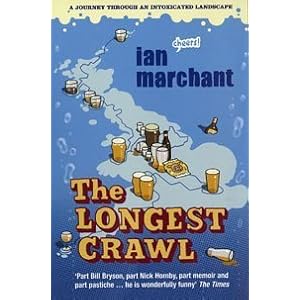
"The Longest Crawl," by Ian Marchant

Creative Commons License
Stuff and Nonsense by Amy Cockram is licensed under a Creative Commons Attribution-Noncommercial-No Derivative Works 2.0 UK: England & Wales License.

Longest CrawlI found this book for a couple of pounds in The Works (ssh, don't tell the author), and I bought it on impulse because I know a couple of places mentioned in the blurb on the back.

In "The Longest Crawl," Ian Marchant decides to go on a pub crawl for the length of Britain.  And I don't just mean Land's End to John O' Groats, no, that's for amateurs, I mean from the Scilly Isles to Unst in the Shetlands.  He is inspired by G.K. Chesterton's poem "The Rolling English Road" and the idea that the traveller's geography of the UK is inextricably tied to our heritage as a drinking nation.  He takes his friend, Perry, along with him as travelling companion for his month of driving, alcohol and hangovers.

I particularly liked the couple of bits about places I know, which intersected with some of my interests, and, as he travels the length of the UK, chances are that he might also write about somewhere you know and love.  In Plymouth he and Perry go to Prete's ice cream bar, where they are dumbfounded by a Robert Lenkiewicz mural on the wall.  I love Lenkiewicz's work, although I'm ashamed to say I have never been in Prete's, and I could easily highjack this post writing about him (how I saw Lenkiewicz in Plymouth a couple of times but was too intimidated to speak to him; how the dilapidated state of his huge outdoor mural on the Barbican saddens me; how I'd love to see The Riddle Mural at Port Eliot; how if I get rich I would like to own one of his paintings but it will need to be in a room my husband doesn't often go in because he's not keen on his work ).  He goes to Bath - a place I love - and mentions the Natural Theatre Company who I also shouldn't get started on (how I loved their touring shows when I was a teenager and wrote a couple of fan letters; how thanks to them I have a signed photograph of Henry VIII which I am fairly sure is a fake).  These familiar references are a big joy of the book.

In Marchant's book you learn quite a lot about the author himself, as well as learning a lot about the processes of making alcohol (Plymouth Gin, somerset cider, beer).   He is very self-deprecating and plays on the pub-bore side of his personality (without being boring): while his friend Perry flirts with cute barmaids and tour guides, he is the one asking technical questions about brewing and fermenting.  He is funny and frequently quite politically incorrect (with, I think, no malice), and he is very thoughtful along the way about the UK's historically fraught relationship with the demon drink

He also has a nice line in snoring similes ("like a donkey with emphysema" "like a dinosaur gargling wallpaper past").  But it's hard to beat the simplicity of my Dad telling my Mum that she snores like "an enraged warthog" (rude), or Mark telling me on various nights of the same cold that I made sounds in my sleep like "a startled baby otter" or, my personal favourite, a "disconsolate elk".

This was an interesting and entertaining book.  I'm thinking of getting one of Ian Marchant's earlier books "Parallel Lines," about our railways, as a present for my father who is a bit of a train fanatic.  Ssh, don't tell my Dad.

Thursday, 10 May 2012

"The Last Werewolf," by Glen Duncan

Creative Commons License
Stuff and Nonsense by Amy Cockram is licensed under a Creative Commons Attribution-Noncommercial-No Derivative Works 2.0 UK: England & Wales License.

Life, like the boring drunk at the office party, keeps seeking you out, leaning on you, killing you with pointless yarns and laughing bad-breathed in your face at its own unfunny jokes.

I'm a little bit early with this post, but I wanted to get it written while it was still fresh in my mind; early because this is the one of the choices of The Readers Summer Book Club and it isn't up for discussion yet.  The Readers podcast - if you haven't already discovered it and, if you haven't, you really should check it out - is a very entertaining UK based podcast about books.  This is one of a few podcasts that I look forward to every week (along with the Mark Kermode and Simon Mayo movies podcast and, of course, the podcasts that my husband is on), and it is available from the link above and also on I-Tunes.  I'd heartily recommend it.  The Bookrageous podcast is also good but, as this is US based, I've occasionally been frustrated when they have talked about books that sound great but don't seem to be readily available in the UK.

Anyway, I already had "The Last Werewolf" on my list of books to read since hearing about it on the Bookrageous podcast - and, by coincidence, I had already borrowed it from the library when I heard that it was one of the book club picks. 

Glen Duncan's anti-hero is Jacob Marlowe.  Jake is just over two hundred years old, and for one hundred and sixty-seven of those years he has turned into a werewolf at every full moon.  And Jake is a marked werewolf, as the incredibly successful attempts of WOCOP (World Organisation for the Control of Occult Phenomena) to eradicate werewolves mean that he is the last one left.  Jake has been managing to evade them, but they seem to be catching up with him, and he seems to have also attracted the attention of some vampires (which is odd as they normally revile werewolves).  In addition, "The Last Werewolf" is also partly a love/lust story, with a strong wolfish libido, so you would be advised not to buy this book for an easily shocked maiden aunt as a present. 

What sets this book apart from the glut of other vampire and werewolf novels, is Duncan's use of language.  I haven't read any of his other novels, but I gather that Duncan is an established, although previously not incredibly famous, "literary" writer.  Duncan's novel is mostly first person in Jake's voice, and I found Jake to be a very articulate and entertaining narrator.  In a nice touch, I found myself occasionally aware of little elements of ever-so-slightly archaic sounding language that seem fitting for a narrator who has been on the earth for such a length of time.  A couple of quotes which I loved have popped up in my Facebook timeline when I wanted to share them with friends (cars stopped by snow are "poignantly stupefied").  I rarely feel moved to quote from books in this way but when you discover an insult as brilliant as "pug-faced lolloper," you just have to share it. 

This magnificent insult also beings me to another thing I love about this book - yes, it is dark, but it has some wonderful moments of black humour sprinkled through the narrative.     I was particularly fond of an early passing reference to Jake having "eaten a forty-three-year-old hedge fund specialist."  I'm not sure why I found this funny - perhaps the specificity of the age, the profession; the matter of fact and mundane way this is mentioned - but when I reached this on page 5, I knew that I was probably going to enjoy this book.

Duncan's take on vampires is different from the kitsch, glittery, costume-jewellery vampires of Stephenie Meyer (thank heavens), and the werewolf is a dangerous, primal creature and not just a hunky man who every so often ends up naked in the woods.  There is another quote that I put on Facebook, so my friends on there might recognise it, which I found amusing.  I'm torn because I don't want to include it here - it's not a plot spoiler, but it is an ideological spoiler - but I want to re-quote it because I love it.  My solution to this is that I will quote it in the first comment on this post - if you are planning to read the book and don't want a funny couple of lines to be spoiled, then don't read the first comment.  Even if you are planning to read this book and do read this quote, there is a lot more to Glen Duncan's vampires than this quote might suggest.

"The Last Werewolf" is apparently the first in a trilogy.  The second in the series, "Talulla Rising," is now out, but my local library doesn't seem to have a copy (which is a form of torture for a committed bibliophile).  I'm considering buying it, and my willpower might yet wane when it comes to the next full moon...

Wednesday, 11 April 2012

"How to be a Woman," by Caitlin Moran

Creative Commons License
Stuff and Nonsense by Amy Cockram is licensed under a Creative Commons Attribution-Noncommercial-No Derivative Works 2.0 UK: England & Wales License.

It is no surprise that I like this book, since my last 3 posts have been quotes from it.  I was even considering giving it 5 stars on Goodreads, but I think I will give it a 4 (the perfect 5 star read is as mythical as the griffin).

I thought that I was going to like this book when I read the prologue, as I liked her sense of humour.  By page 12, when she said that Germaine Greer was her heroine, I knew that I was going to love it.  I, too, love Germaine Greer because she is a truly excellent mix of being passionate, articulate, intelligent, funny and occasionally barking mad.  I have seen her talk twice, the first time at a feminism conference at which her talk was inspirational - then a later speaker who I won't name came on with a self-aggrandising "feminism-was-great-once-but-now-it's-all-shot-to-hell" litany and completely undid her good work.  Germaine Greer is still fighting; this other woman was giving up.

Caitlin Moran isn't giving up either.  Her book is very funny - I hope my few previous quotes have shown this - but she also seems to be trying to take feminism out of realms of the abstract and theoretical and into the everyday, practical world.  It should be something for real women, and not just fusty academics.  According to her, there is a quick way to work out if you are a feminist:
Put your hand in your pants.
a) Do you have a vagina? and
b) Do you want to be in charge of it?
If you said "yes" to both, then congratulations!  You're a feminist.
Her writing takes in experiences and choices that women face throughout their lives: sexism in the workplace, brazilian politics (and I don't mean the country), marriage, motherhood and abortion.  I would recommend the chapter in which Caitlin relates the difficult and painful birth of her first child to anyone who is feeling broody and - whether it is down to lack of finance, inadequate accommodation, being without a partner or with the wrong partner, or whether it is just not happening - is not currently pregnant.  Her experience is likely to make you feel a lot happier about that; it is an excellent antidote to broodiness and could probably be used as a contraceptive.  If you are currently pregnant, it might be best avoided.  It might be a short-lived antidote, however, as her second labour is easier and she writes about the pleasures - as well as the hard-work - of having children.

It was interesting to read this book, having just read "Eat, Pray, Love" before, as the two are very different.  Elizabeth Gilbert's book is very much a spiritual journey, whereas Caitlin Moran's book is about learning to live as a woman in the physical world with which we are blessed (or which we are stuck in, depending on what kind of a day you've had).  I gave both 4 stars on Goodreads for very different reasons but, if you are a girl and you are only going to read one of these, I'd pick "How to be a Woman."  You might not learn how to meditate, but it might help you to laugh and deal with that bad day at the office.

Wednesday, 4 April 2012

Another quote from "How to be a Woman"

Creative Commons License
Stuff and Nonsense by Amy Cockram is licensed under a Creative Commons Attribution-Noncommercial-No Derivative Works 2.0 UK: England & Wales License.

I think that this will be my last quote until I write a review of this book.  I just found this very funny.

The bra is, perhaps, the rudest item of women's clothing.  If you do not doubt this, try this simple test: throw a bra at a nine-year-old boy.  He will react as if he has had a live rat wanged at his head.

I think it is the excellent use of the word "wanged" that makes me love this quote.

Tuesday, 3 April 2012

Today's Caitlin Moran quote

Creative Commons License
Stuff and Nonsense by Amy Cockram is licensed under a Creative Commons Attribution-Noncommercial-No Derivative Works 2.0 UK: England & Wales License.

When the subject turns to abortion, cosmetic intervention, birth, motherhood, sex, love, work, misogyny, fear, or just how you feel in your own skin, women still won't often tell the truth to each other unless they are very, very drunk.  Perhaps the endlessly reported rise in female binge-drinking is simply modern women's attempt to communicate with each other.  Or maybe it is because Sancerre is so very delicious.  To be honest, I'll take bets on either.

Monday, 2 April 2012

A quote from Caitlin Moran's "How to be a Woman"

Creative Commons License
Stuff and Nonsense by Amy Cockram is licensed under a Creative Commons Attribution-Noncommercial-No Derivative Works 2.0 UK: England & Wales License.

I wanted to quote an extract from this, because I am discovering that I really love this book.  It might even be a five star on Goodreads - and I am quite conservative with my stars, so I think it would be my first.

Please don't think of the previous paragraph as a spoiler for my review in a couple of days time.  I prefer to think my "How to be a Woman" review as the blog equivalent of an episode of "Columbo:" you already know who did it - or you already know I like it - but you still go along with it to see how Columbo (that's me, in this rather suspect metaphor) gets there.

Over the next couple of days while I am reading the book, before I write my review, I might post a quote that I've loved each day.  The bit I thought I would post today is the longest I wanted to quote...
What I AM going to urge you to do, however, is say "I am a feminist".  For preference, I would like you to stand on a chair, and shout "I AM A FEMINIST" - but this is simply because I believe that everything is more exciting if you stand on a chair to do it.

It really is important you say these words out loud.  "I AM A FEMINIST."  If you feel you cannot say it - not even standing on the ground - I would be alarmed.  It's probably one of the most important things a woman will ever say: the equal of "I love you", "Is it a boy or a girl?" or "No! I've changed my mind! Do NOT cut me a fringe!"

Say it.  SAY IT!  SAY IT NOW! Because if you can't, you're basically bending over, saying, "Kick my arse and take my vote, please, the patriarchy."

And do not think that you shouldn't be standing on that chair, shouting "I AM A FEMINIST!" if you are a boy.  A male feminist is one of the most glorious end-products of evolution.  A male feminist should ABSOLUTELY be on the chair - so we ladies may all toast you, in champagne, before coveting your body wildly.  And maybe get you to change that light bulb, while you're up there.  We cannot do it ourselves.  There is a big spider's web on the fitting. 

Sunday, 11 March 2012

My tribute to Douglas Adams on (what would have been) his 60th birthday

Creative Commons License
Stuff and Nonsense by Amy Cockram is licensed under a Creative Commons Attribution-Noncommercial-No Derivative Works 2.0 UK: England & Wales License.

I have been on Twitter and Facebook today, and it is great to see so many people quoting and paying tribute to Douglas Adams.  I love his writing, and was saddened by his early death; it is sad when anyone dies so comparatively young and leaves behind a wife and child, but I was also selfishly sad in regretting the loss all the wonderful writing that we could have had if he had lived on.

So I just joined in the tributes on Twitter by quoting the first couple of lines of Vogon poetry.  When I was a teenager I decided to memorise Vogon poetry - I really can't remember why - and I was curious to see how much I could recall.  I put on the first couple of lines, and checked my accuracy only to find that I was just a bit out on the punctuation.  So, as my own slightly unusual tribute to the great Douglas Adams, I thought I would see how much more I can remember.  When I checked on the first couple of lines I did not look on further, so this is continued entirely from memory...

Oh freddled gruntbuggly thy micturations are to me
As plurdled gabbleblotchits on a lurgid bee
Oh Groop, I implore thee
My foonting turlingdromes
And hooptiously drangle me with crinkly bindlewurdles,
Or I will rend thee in the gobberwarts with my blurdlecruncheon, see if I don't!

So how did I do?  I think I am probably still off with the punctuation, but hopefully I was pretty accurate.  I'm about to dig out my copy and check.

Thank you, DNA, for all the brilliant writing, the ideas and the laughs that you gave us.

Friday, 9 March 2012

"Explosive Eighteen,' by Janet Evanovich

Creative Commons License
Stuff and Nonsense by Amy Cockram is licensed under a Creative Commons Attribution-Noncommercial-No Derivative Works 2.0 UK: England & Wales License.

It's no secret that I love Janet Evanovich's Stephanie Plum series - I wrote about the previous one here - so it is unusual that, although I bought this book when it first came out, I hadn't got around to reading it yet.  Normally, when there is a new Stephanie Plum it jumps immediately to the top of my reading pile.  It's indicative of my spate of low library willpower that it has has taken me this long to get to it.

In the 18th in the series, Stephanie has returned early from a disastrous holiday in Hawaii that she doesn't want to talk about - and she especially doesn't want to talk about why she has a tan line on her ring finger.  Our hapless heroine finds a mysterious photo in her hand luggage, which some very dangerous people seem to want to get their hands on, and the man who sat next to her for part of the plane journey is found dead at LAX.  She also returns to work to find that one of the "skips" who she has to track down is her arch-nemesis Joyce Barnhardt, who she once discovered doing the nasty with her husband (now ex, understandably) on the dining table. 

I've been thinking in the past few months that one of my failings as a reader is that I read too quickly, and don't read deeply enough.  However, reading "Edge" and now this has made me realise that perhaps some things are meant to be read quickly - thrillers should have pace, and make you want to read quickly to find out what will happen next.  If your reading experience of a thriller drags, then maybe the book isn't doing what it set out to do.

I've just checked and there doesn't seem to be a release date for number 19, but I'm sure there will be another in the series that just seems to keep on going.  In some ways that is a good thing because I look forward to the new Stephanie Plum - it's hard to beat the series for a fun, entertaining ride -  but I would like to see the triangle between Stephanie, Ranger and Morelli come to a resolution....

Monday, 5 March 2012

"The Coincidence Engine," by Sam Leith

Creative Commons License
Stuff and Nonsense by Amy Cockram is licensed under a Creative Commons Attribution-Noncommercial-No Derivative Works 2.0 UK: England & Wales License.

I've wanted to read this book for a while, having first heard of it via a review (I think in "SFX") that compared the central idea of a coincidence engine to Douglas Adams' Infinite Improbability Drive.  I love Douglas Adams' writing - although my husband and I disagree over whether the radio series of "The Hitch Hiker's Guide to the Galaxy" is better than the books (no prizes for guessing which way I lean) - so this comparison was enough to make me want to track down Sam Leith's novel. 

Alex Smart, a Cambridge postgraduate, is on an impulsive trip to America to surprise his girlfriend and propose to her.  He is being followed by Sherman and Davidoff, employed by MIC Industrial Futures, who believe that Alex is in possession of a coincidence engine that was created by an eccentric, reclusive mathematician Alex Banacharski.  He is also being pursued by Bree and Jones, agents of the Directorate of the Extremely Improbable (DEI), who are under the direction of Red Queen.  Sherman and Davidoff have no scruples about hurting or killing Alex to get the coincidence engine, but Bree and Jones want to get there first and protect Alex.

The DEI is a great creation, and Red Queen - who interestingly I believe remains ungendered through the whole narrative (if I'm wrong and I missed a gendered pronoun, please let me know) - is in very tenuous control of the operation.  The DEI is a large scale operation, and Red Queen lays out their remit:
Our job is to assess threats to national security that we don't know exist, using methods that we don't know work.  This produces results that we generally can't recognise as results, and when we can recognise them as results, we don't know how to interpret them.
The DEI deals in "unknown unknowns," a phrase which echoes a speech of former US Secretary of Defense, Donald Rumsfeld, who, in the world Sam Leith creates, has reinstated the DEI.  Its work is such a paradox that it is in danger of disappearing up its own USB port.  The office of the DEI under New York has a large staff of unconventional spooky employees such as tea-leaf readers and psychics, and it tunes into information from the mass media (which, brilliantly, doesn't mean what you think it does in the world of the DEI). 

If the DEI is a bit like a large scale "X-Files," then Bree and Jones are Sam Leith's off-kilter Scully and Mulder to the Skinner of Red Queen.  Bree is an overweight, recovering alcoholic with a predilection for Jolly Rancher candy; Jones is apsychotic (he has no imagination and no understanding of consequences), a chain smoker and has an eidetic memory (he remembers exactly everything that has ever happened to him).  Jones makes a nice opposite to the character of Alex: while Alex feels that he is always doing what is expected of him, Jones has no concept of expectations. In comparison with Jones, Fox Mulder is a well-adjusted and balanced individual.  Bree and Jones make a unique couple; I found the character of Jones particularly fascinating and sometimes poignant, and his eccentricities are balanced by the sympathetic and vulnerable character of Bree who is easier to relate to. 

Aside from comparing the coincidence engine with the Infinite Improbability Drive, Sam Leith also has an occasional Adams turn of phrase (a man has injuries consistent with "the rough prognosis for an eight-year-old child with rickets spending a half-hour in an industrial tumble dryer").  In its moments of darker absurdity I also thought of "Catch 22," which I have hazy memories of reading years ago. I enjoyed the flashes of absurd humour in the novel, and the coincidence engine is a wonderful out for an author to get away with any kind of unlikely plot twist (but that would never happen?  Well, yes, that's kind of the point). The novel is an interesting blend of mathematics and physics with a touch of philosophy and a dollop of humour, but I have to confess that at times my puny brain found it hard to get around some of its ideas - although it was no less entertaining for that.

Friday, 20 January 2012

"Snuff," by Terry Pratchett

Creative Commons License
Stuff and Nonsense by Amy Cockram is licensed under a Creative Commons Attribution-Noncommercial-No Derivative Works 2.0 UK: England & Wales License.

One thing I like to try and do at the start of a review is declare any bias that I might have.  I, therefore,  have to admit that I am long-standing fan of Terry Pratchett's writing.  I am always impatient to get his books, so I bought this one as soon as it came out and then, in a feat of willpower (not something with which I am normally well-endowed), I decided to save the pleasure of reading it for my Christmas holiday.

In "Snuff," Commander Vimes of the City Watch reluctantly goes on a compulsory holiday with his wife, Lady Sybil, and their young son.  They go to his wife's ancestral home in the country, where the egalitarian Vimes is deeply uncomfortable with the idea of being master of a house full of servants.  He misses the reek of Ankh Morpork, but soon comes to realise that something in the country smells bad - and not just because his son has become obsessed with poo.

If I'm honest, it was possibly easier for me to delay starting this book because I knew it was a Sam Vimes book; he is a character that I have liked in previous books, but not loved.  If it had been a book that featured the witches, the wizards, or Death (some of my favourite Discworld denizens) my impatience to start the book might have been insurmountable.  However, I loved Sam Vimes in this novel and I now feel like I should re-read earlier books and re-evaluate my feelings for him.  For me, the strength of this book was the warmth and humour in the relationship between Sam and his wife, Lady Sybil.  Lady Sybil is a great character - I was going to write a great female character, but that would be like giving the Orange Prize when you could be giving the Booker - and I finished the book thinking that I would want to be like her: she is strong, passionately principled (like her husband), compassionate, a great mother to young Sam and a warm human being.  Physically I'd need to gain some weight, but I seem to be naturally heading in that direction anyway.

I have dug out my copy of "Guards, Guards." as I decided that I would now like to go back and read the novel in which Sam and Sybil met.  In general I feel like I need to give Terry Pratchett's earlier books another chance, as I remember enjoying them less than more recent books.  The Discworld is a feat of imaginative creation that has grown in depth and detail as the series has progressed and evolved, and I felt that earlier books were less rich and resonant.  It has been a long time since I last read them though, so I am aware that I might be undervaluing them.  In addition, some of the best science fiction and fantasy provides an alternative commentary on the world in which we live - and to the best of my recollection his more recent books seem to do this more effectively.  His books have become darker satires on modern life, and I prefer that darkness: they are more seriously funny.  I was aware in "Snuff" that the moral commentary on prejudice and narrow-mindedness in society is ground that he has trodden well before in his later books, but I forgive him that because he does it so damn well.

I still find his books very funny and I love his inventive use of language, but there is a bitter-sweetness to every new Terry Pratchett novel because I am aware that his illness means that new Terry Pratchett books are in limited supply.  The serious illness of any human being is tragic, but I am selfishly aware that I am also sad that each new book takes us closer to the last new book.  I just have to hope with every new book that there will be one more....

Friday, 30 December 2011

"The Death Relic," by Chris Kuzneski

Creative Commons License
Stuff and Nonsense by Amy Cockram is licensed under a Creative Commons Attribution-Noncommercial-No Derivative Works 2.0 UK: England & Wales License.

Last year I read a series of books by Chris Kuzneski, all focusing on the exploits of his heroes Payne and Jones, and I wrote about them here.  I thought that the series was good, rollicking fun, so I was pleased to hear that he had written a new book in the series called "The Death Relic."

In his new novel, Kuzneski's ex special forces heroes are called by Maria Pelati - a character who also appeared in the earlier novel, "The Sign of the Cross," and Jones' now ex-girlfriend - because she is in danger.  Maria has gone to Mexico in answer to a job offer from renowned fellow archaeologist Terrence Hamilton, who then disappears and she finds that her hotel room has been ransacked.  The pair leave snowy Pittsburgh - Jones hates the cold - to answer her distress call, but unresolved feelings make the reunion a fractious and prickly one.  A parallel plot about the kidnap and ransom of the children of a powerful Mexican criminal converges on the central mystery of Hamilton's disappearance, leading them to mysterious and exotic Mexican locations.

This was a strong entry in a series that continues to entertain, and to hold my attention.  I know very little about Mayan civilisation - I haven't even seen the Mel Gibson film "Apocalypto" - so the exotic locations and historical background were relatively fresh and new to me.  Payne and Jones are sparky and funny, as usual, and Maria's obstreporousness adds an interesting dimension to the dynamic.  Some extra warmth and comic relief was added by the semi-regular figure of the ebullient Petr Ulster, who has become possibly my favourite character of the series: Petr seems to revel in the thrill of joining Payne and Jones on their adventures, despite his rotund figure and love of material comfort making him better suited for book-study than fieldwork. 

I think I favour the character of Petr Ulster because I, too, have a (slightly) portly figure that makes me better suited to reading than action: with that in mind I will probably continue to join Payne and Jones on their next adventure while remaining in the safety of my own chair (or, my favourite reading location, bed) with a cup of coffee.

Friday, 23 December 2011

"Soulless," by Gail Carriger

Creative Commons License
Stuff and Nonsense by Amy Cockram is licensed under a Creative Commons Attribution-Noncommercial-No Derivative Works 2.0 UK: England & Wales License.

I would like to thank my friend Sarah for recommending this series of books.  "Soulless" is the first of "The Parasol Protectorate" series and, having borrowed this from the library, I have now had to buy the next three for my reader because I couldn't stand to wait until after Christmas to get the others on reservation. 

Gail Carriger's series of novels is set in an alternate version of Victorian England, in which humans live slightly uneasily alongside a minority of vampires, werewolves and ghosts.  Her heroine is Alexia Tarabotti - statuesque, half-Italian, and therefore not conforming with the accepted English rose standard of beauty - who also happens to be preternatural (which means that physical contact between her and a supernatural being like a werewolf or vampire can make them human for the duration of her touch).  Vampires and werewolves might be in a minority, but preternatural beings are even rarer and are registered with the Bureau of Unnatural Registry (BUR).  When Alexia kills a vampire who, unaware of vampire etiquette, tries to bite her without her consent, she attracts the further attention of Lord Maccon of the BUR - who just happens to be uncouth, devastatingly attractive and a werewolf.  This encounter with a rogue vampire leads Alexia and Lord Maccon into a dangerous mystery.

I already did the "Twilight" comparison with "A Discovery of Witches," but - much as I have tried to avoid the bleeding obvious - it also came to mind with this novel.  If "Twilight" was thought of as having an abstinence agenda, this has a get-your-well-built-male-hero-naked-as-often-as-possible agenda (which I personally found more enjoyable).  If Stephenie Meyer tried to gloss over the idea that, when a werewolf changes back into being a man, you are essentially left with a nude bloke, Gail Carriger positively revels in that nudity.  Lord Maccon is often naked in Alexia's presence at great length, so to speak, and in one entertaining instance is nude for pretty much a whole chapter (and they are reasonably lengthy chapters).

But far be it from me to imply that this book is mainly notable for hot werewolves.  Gail Carriger is inventive, irreverent and funny in a way that reminds me, in spirit although not in content, of authors I enjoy like Jasper Fforde and Janet Evanovich.  This novel also reminded me of "The Vesuvius Club," only I enjoyed it a lot more.  Although the fact that it made me think of other authors might make it sound derivative, there are elements to this novel that I thought were unusual.  In Gail Carriger's re-imagination of Victorian England she creates a detailed world of vampire and werewolf society and etiquette, as well as detailing a pseudo-scientific study of the nature of her supernatural and preternatural creations.  The idea of a preternatural being was new to me and, in Alexia Tarabotti, Carriger has a strong, independent and entertaining heroine.

This Christmas I seem to be going a little bit steampunk, a little bit alternative history, since, as well as Carriger's subsequent novels in the series (the fifth and supposedly last is due to be published in March), I have a couple of Kim Newman's Victorian re-imaginings to read or listen to on audiobook in my holiday.  If, like me, you feel a little bit old for the jailbait world of "Twilight," Gail Carriger's novels are a full-blooded alternative for consenting adults.